About Me
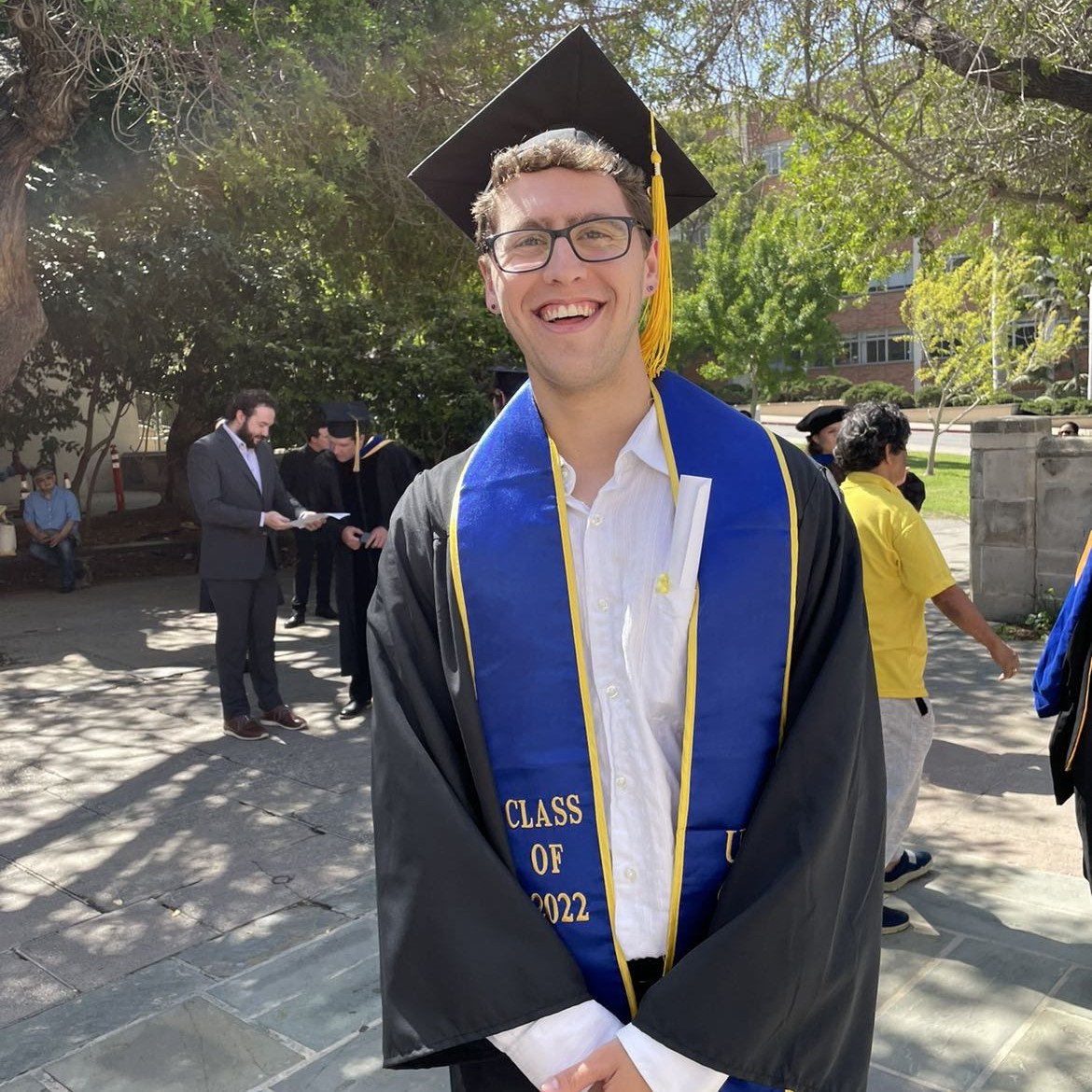
I am an observational astronomer interested in exoplanet formation and evolution, as well as improving the detection and characterization of exoplanets.
I grew up outside of Milwaukee, Wisconsin, then attended the University of California, Los Angeles for my undergraduate degree. While there, I worked with Dr. Andrea Ghez and Dr. Shoko Sakai in the UCLA Galactic Center Group, studying ways to improve the astrometric data pipeline for the group. I graduated from UCLA in 2022 with my B.S. in astrophysics, then spent an additional year doing full time research as a post-bac with the Galactic Center Group.
Since 2023, I have been a Ph.D. student in the astronomy department at the University of Wisconsin — Madison. I work with Dr. Thomas Beatty doing observational studies of exoplanets, which you can read about more on my research page. I received my M.S. in astronomy from UW — Madison in 2025, and expect to complete my Ph.D. in 2028.
Outside of astronomy, I enjoy rock climbing at local gyms (or watching the pros compete), playing board games and videogames, watching the NBA (go Bucks!). I also used to work as a summer camp counselor, and generally enjoy being outdoors to camp, hike, and/or canoe.
Research
My research focuses primarily on observational studies of exoplanets and their host stars. My main intersts include exoplanet formation and evolution, and what we can learn about those from observations. I also work on ways to improve our ability to detect and characterize exoplanets.
Exoplanet Detection and Characterization
Since beginning graduate school, I have been using UW — Madison's institutional access to the WIYN telescope to lead an RV follow-up program on about three dozen TESS planet candidates using the NEID high-resolution spectrograph. I have primarily been targeting planet candidates that best leverage NEID's world class RV precision and would be difficult to follow up with most other spectrographs.
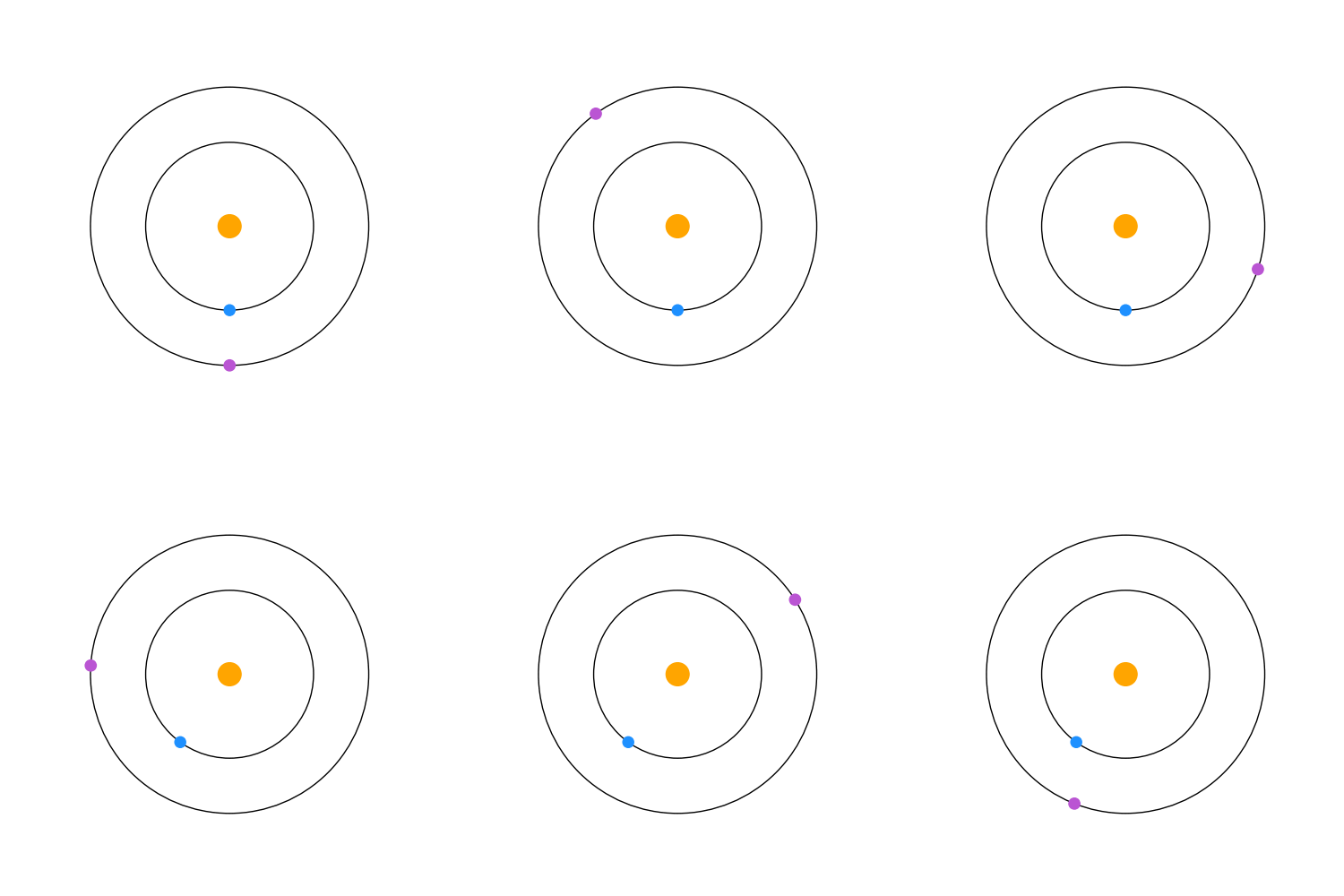
Example animation of the 5:3 orbital resonance in the TOI-6054 system. The orbital distances are to scale with the stellar radius, and the planet sizes are inflated by a factor of 30 for visibility.
The first system I published was the TOI-6054 system, working with the OrCAS collaboration. I characterized two similarly-sized sub-Neptunes orbiting with less than two week periods, and found that they are most likely in a 5:3 mean motion resonance (see the animation above), indicating a dynamically cool evolutionary history. Additionally, the host star has expanded by a about 150% as it approaches the end of the main sequence, and its luminosity has more than doubled. This has pushed TOI-6054b, the inner planet, to a level of incident flux where few sub-Neptunes have been able to survive with atmospheres intact. Thus, we believe that the planet is likely losing its primordial atmosphere and I have proposed additional follow-up observations to confirm this.
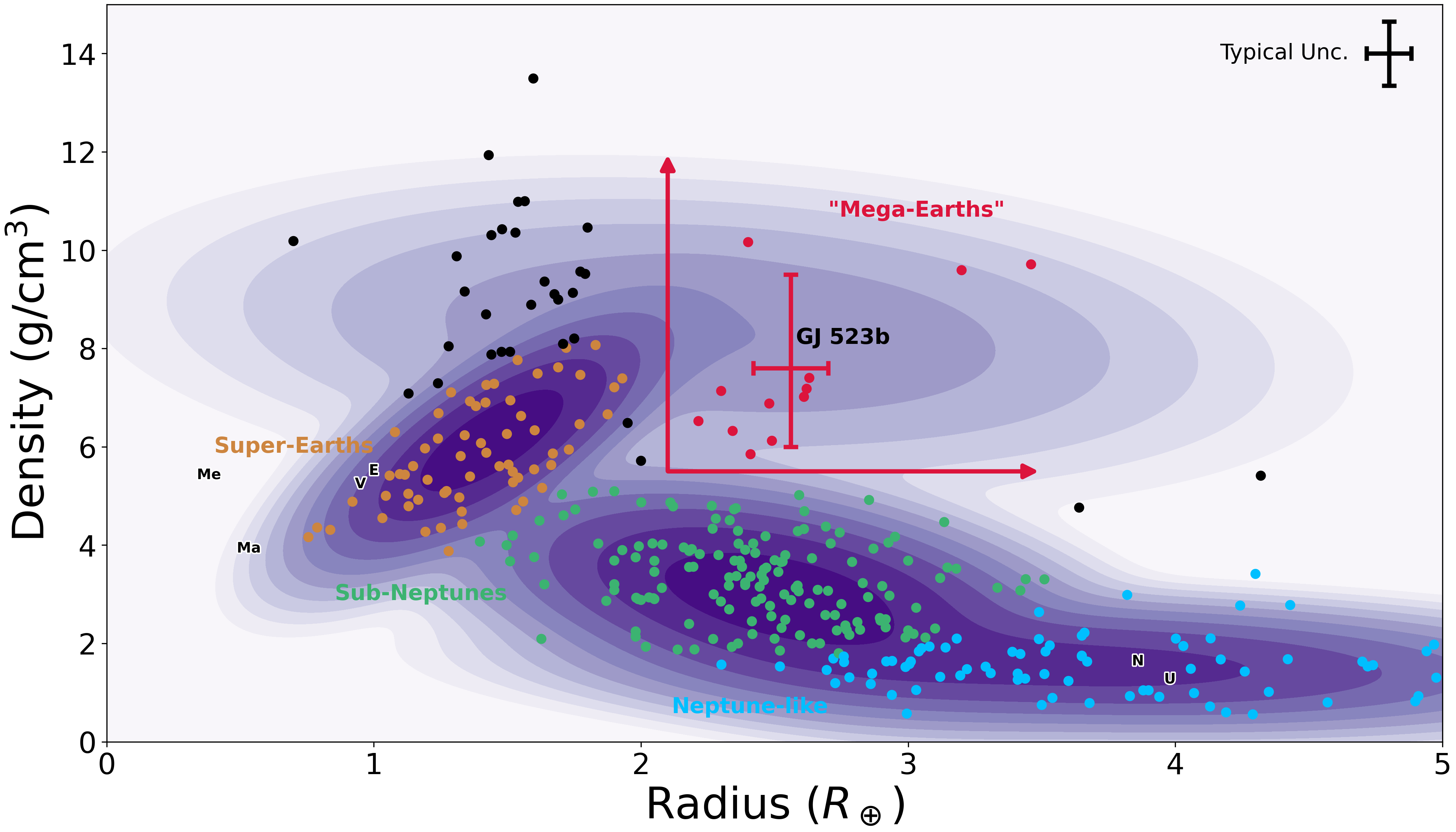 Radius-density diagram of small, well-characterized exoplanets. We show our proposed definition of the mega-Earths in red. We also ran a Gaussian mixture model, which identified the super-Earth, sub-Neptune, and Neptune-like populations, and placed the mega-Earths into an outlier group separate from the sub-Neptunes. Solar system planets are labeled for context.
My second characterization paper, currently under review, is on the planet GJ 523b, and was done in collaboration with WiCOR. We initially targeted the planet as its radius and equilibrium temperature made it a good candidate for a hycean world, however we quickly found that it was much too massive. GJ 523b, despite its sub-Neptune-sized radius, has a mass of 23 earth masses, making an extended atmosphere extremely unlikely. This challenges standard sub-Neptune formation theories, especially when combined with the relative youth of the system (<500 Myr). We also found a small population of outlier planets similar to GJ 523b, which have sub-Neptune radii but densities greater than that of Earth. We call these the mega-Earths after an informal term used for Kepler-10 c, and propose a new observational definition for them (see the above plot).
Mitigating the Transit Light Source Effect
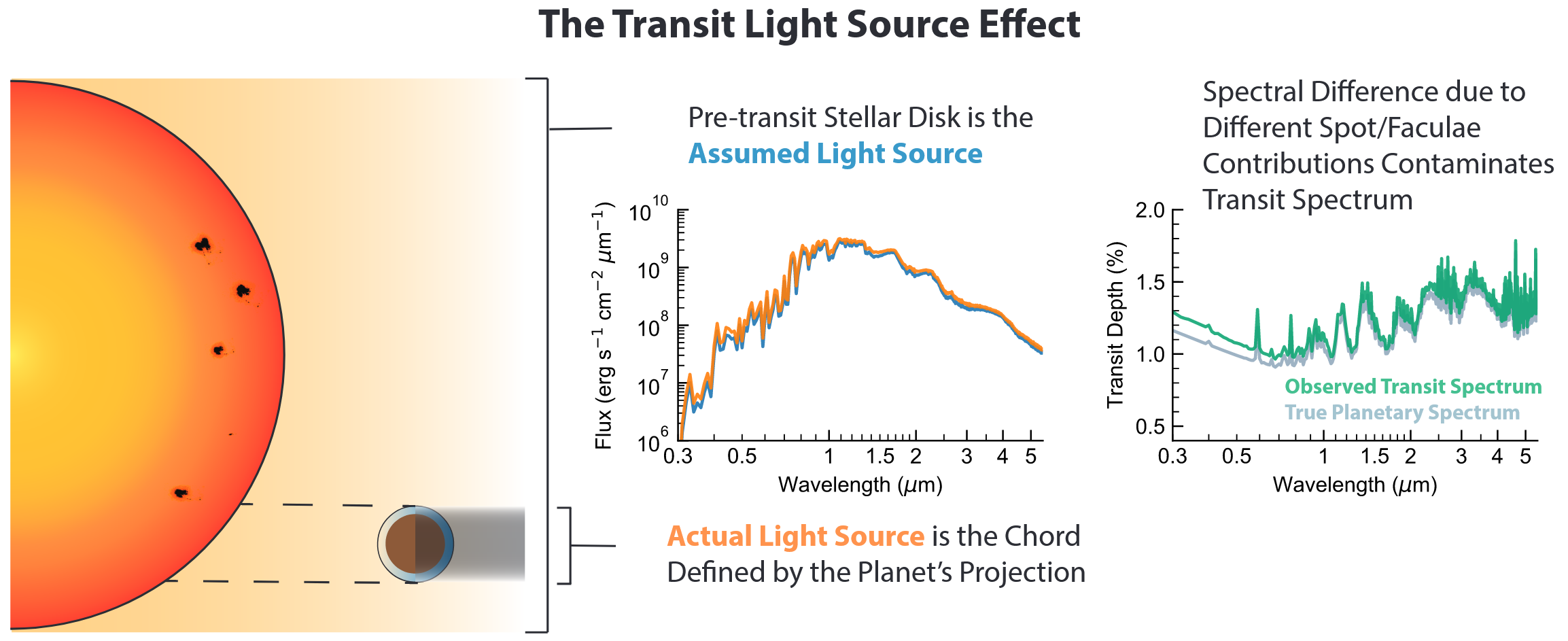 A schematic of the transit light source effect from Figure 1 of Rackham et al. 2018.
Transmission spectroscopy of exoplanet atmospheres measures differences between the incident and transmitted light through the atmosphere. Often, it is assumed that the light source illuminating the planet's atmosphere is just the disk-integrated spectrum of the star. However, heterogeneities in stellar atmospheres can cause the assumed light source to differ from the actual light source, leading to variations in transit depth and misinterpretation of spectral features. This is known as the transit light source effect (TLSE), and is considered the rate-limiting step in accurately measuring the atmospheres of exoplanets with JWST.
If the spot covering fraction and contrast ratio of a planetary host star is known at the time of a transit event, it is possible to evaluate and remove TLSE biases. The problem, however, is how to determine those properties. Currently, the method to estimate spot properties is to search for photometric variability in TESS data of a host star, and use this to back out the spot covering fraction and contrast. Unfortunately, this approach has several problems.
I have ongoing work investigating the efficacy of using high-resolution, ground-based, optical spectra to characterize starspots. The goal is to develop a straightforward procedure for astronomers to use to characterize stellar heterogeneities from the ground with a single obseravtion, simultaneous with JWST transmission observations.
FASHION Collaboration
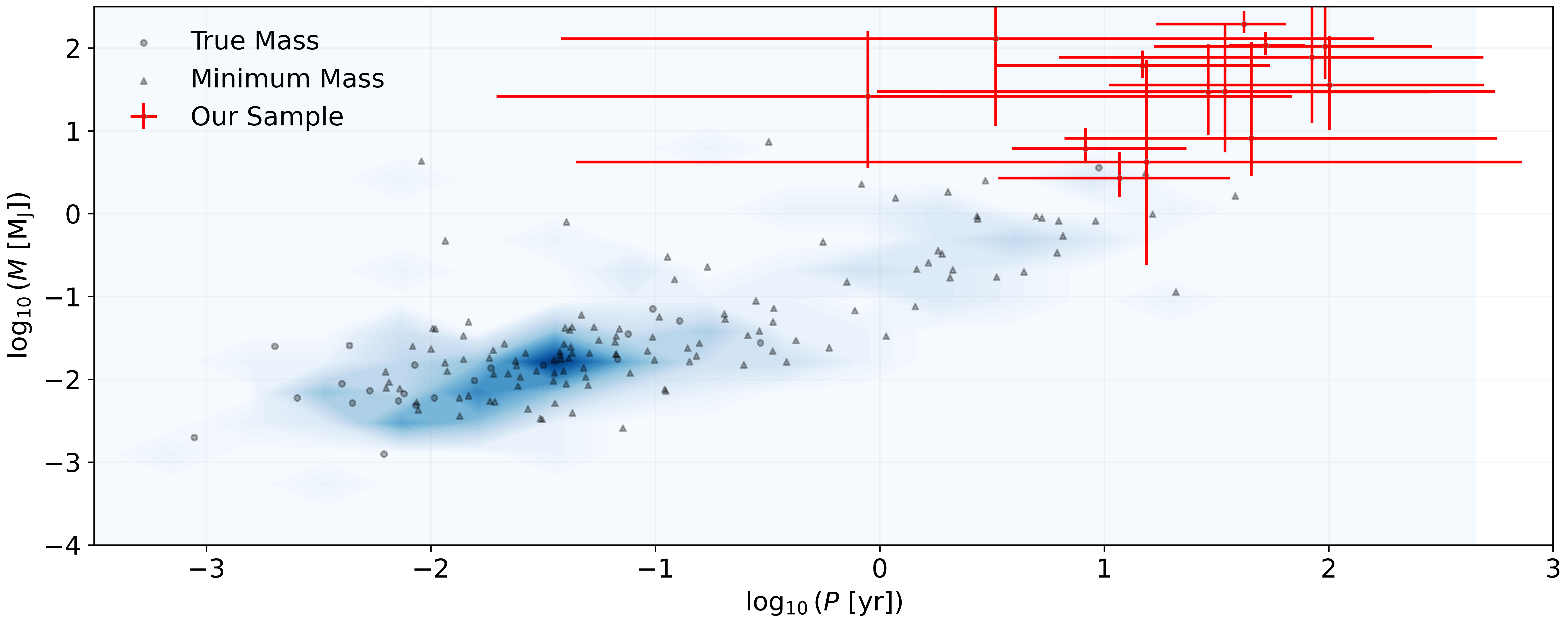 Mass period diagram of known exoplanets in gray, with our best estimates for our FASHION targets in red.
I am also working with the Faint Accelerating Stellar Hosts in Our Neighborhood (FASHION) collaboration to follow-up long period giant planet candidates identified via Gaia-Hipparcos astrometric accelerations. I am leading the follow-up effort on NEID, carrying out long term RV monitoring to search for the signals of these candidates. Our targets are shown in mass-period space in the figure above.
Code
Alfred

The Awesome Library For Robust Exoplanet Detection (Alfred) is an open-source python package I have developed for fitting transit and radial velocity data for an arbitrary system of planets.
It is built around the emcee MCMC sampler and the batman transit models, as well as the isochrones stellar model interpolator to fit stellar parameters.
The goal of the package is to be flexible with easy-to-understand initialization files and user-defined priors, so that users can quickly set up fits for whatever combination of data and planets they want.
The package is pip installable as Alfred-Exoplanets, and documentation is up with tutorials in progress. Check out the github repository or the docs at the links below.
Curriculum Vitae
Here is my full CV.
See the full list of my publications on SciX here.
Contact

Email: mkroft@wisc.edu
Office: Sterling Hall 3511B; 475 N Charter St, Madison, WI 53706
LinkedIn
Elements
Text
This is bold and this is strong. This is italic and this is emphasized.
This is superscript text and this is subscript text.
This is underlined and this is code: for (;;) { ... }. Finally, this is a link.
Heading Level 2
Heading Level 3
Heading Level 4
Heading Level 5
Heading Level 6
Blockquote
Fringilla nisl. Donec accumsan interdum nisi, quis tincidunt felis sagittis eget tempus euismod. Vestibulum ante ipsum primis in faucibus vestibulum. Blandit adipiscing eu felis iaculis volutpat ac adipiscing accumsan faucibus. Vestibulum ante ipsum primis in faucibus lorem ipsum dolor sit amet nullam adipiscing eu felis.
Preformatted
i = 0;

while (!deck.isInOrder()) {
    print 'Iteration ' + i;
    deck.shuffle();
    i++;
}

print 'It took ' + i + ' iterations to sort the deck.';
Lists
Unordered
- Dolor pulvinar etiam.
- Sagittis adipiscing.
- Felis enim feugiat.
Alternate
- Dolor pulvinar etiam.
- Sagittis adipiscing.
- Felis enim feugiat.
Ordered
- Dolor pulvinar etiam.
- Etiam vel felis viverra.
- Felis enim feugiat.
- Dolor pulvinar etiam.
- Etiam vel felis lorem.
- Felis enim et feugiat.
Icons
Actions
Table
Default
| Name |
Description |
Price |
| Item One |
Ante turpis integer aliquet porttitor. |
29.99 |
| Item Two |
Vis ac commodo adipiscing arcu aliquet. |
19.99 |
| Item Three |
Morbi faucibus arcu accumsan lorem. |
29.99 |
| Item Four |
Vitae integer tempus condimentum. |
19.99 |
| Item Five |
Ante turpis integer aliquet porttitor. |
29.99 |
|
100.00 |
Alternate
| Name |
Description |
Price |
| Item One |
Ante turpis integer aliquet porttitor. |
29.99 |
| Item Two |
Vis ac commodo adipiscing arcu aliquet. |
19.99 |
| Item Three |
Morbi faucibus arcu accumsan lorem. |
29.99 |
| Item Four |
Vitae integer tempus condimentum. |
19.99 |
| Item Five |
Ante turpis integer aliquet porttitor. |
29.99 |
|
100.00 |